


Styling a Round Dining Table 100 cm with Armchairs: 5 Pro Checks

There is an undeniable allure to an intimate dining setting where sculpted armchairs embrace guests around an architectural tabletop. When selecting a round dining table 100 cm in diameter, you unlock exceptional spatial intimacy, conversational ease, and a gentle spatial footprint ideal for urban apartments and refined morning rooms. However, the sculptural presence of dining armchairs introduces critical dimensional challenges that require careful consideration before committing to a final ensemble.
While armless side chairs tuck seamlessly beneath standard aprons, armchairs demand deliberate planning around horizontal girth, armrest elevation, and visual density. Pairing expansive seating with a compact footprint can either produce a bespoke sanctuary of quiet luxury or an overcrowded bottleneck. The following five architectural checks ensure your chosen pairing achieves aesthetic balance and seamless ergonomic comfort.
1. Table Base Architecture: Pedestal Centrality vs. Splayed Legs
The foundation of your dining composition dictates how comfortably armchairs navigate the table perimeter. A round dining table 100 cm presents roughly 314 centimeters of total circumference. When dividing this arc among two to four seating positions, floor-level intrusions severely restrict usable legroom and chair alignment.
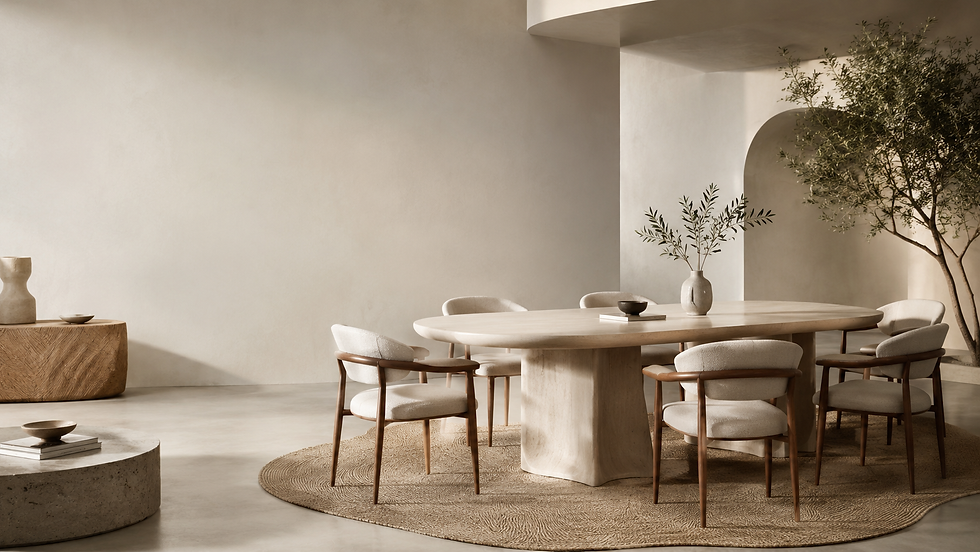
A central pedestal base is the premier architectural companion for armchairs. By consolidating structural support into a weighted fluted column, tulip stem, or tapered plinth, the entire 360-degree perimeter remains free of leg posts. This allows chairs to swivel, angle outward naturally during spirited conversation, and slide inward without colliding with splayed timber or corner brackets.
Conversely, traditional four-legged or tripod dining frames cut into available perimeter space. With four legs positioned at standard 90-degree intervals, the clear span between adjacent legs measures approximately 50 to 58 centimeters at floor level. Because high-comfort dining armchairs frequently span widths between 54 and 62 centimeters, four-legged tables inevitably obstruct armchair entry, forcing seats to stay permanently pushed out.
2. Armrest Height and Apron Tuck-In Clearances
One of the most frequent spatial frustrations in compact dining zones occurs when armchair rests collide with the tabletop perimeter. A round dining table 100 cm typically rests at a standard tabletop height of 74 to 76 centimeters. However, the presence of a structural subframe apron or beveled reverse profile alters the actual clearance underneath.
To achieve a clean visual resting position where chairs tuck under the table surface when not in use, verify the vertical elevation of the armchair arms against the underside of the tabletop:
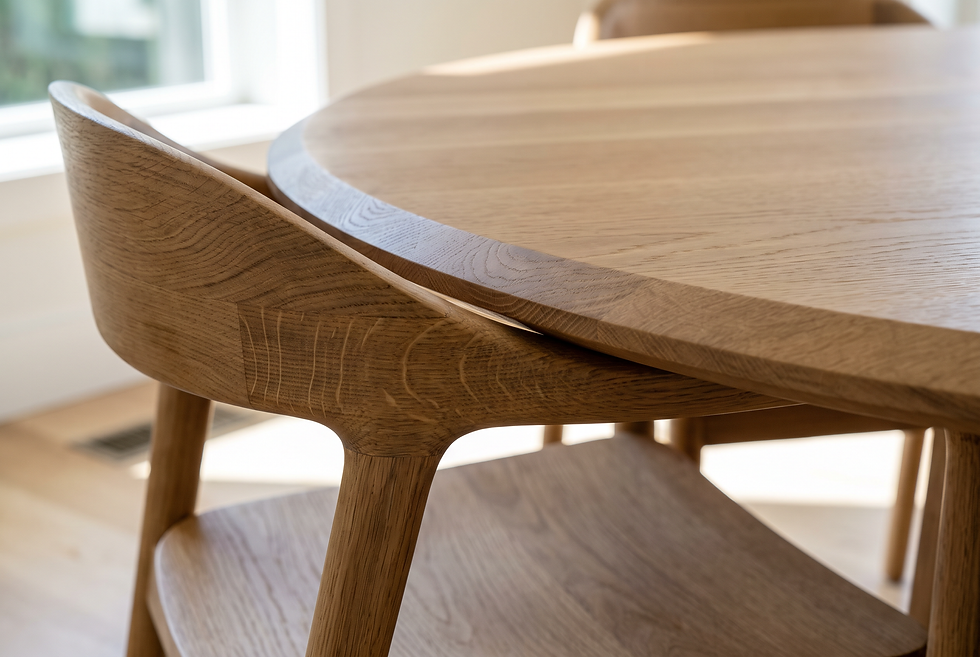
Top-of-Arm Clearance: Aim for a minimum vertical clearance of 2.5 to 4 centimeters between the highest peak of the armrest and the lowest point of the table apron.
Slope and Contour: Modern cantilever and curved tub chairs often feature forward-sloping arms that decline toward the front edge. These sloping profiles glide under tabletop rims far more effortlessly than high, squared-off barrel silhouettes.
Tuck-In Depth: Ensure armchairs can retract at least 25 to 30 centimeters beneath the surface edge. If chairs must remain entirely outside the circumference, perimeter pathways quickly become obstructed.
3. Dimensional Comparison and Clearance Matrix
Understanding the exact mechanical interaction between a 100 cm diameter tabletop and standard armchair specifications prevents costly sizing mismatches. Review the dimensions below to calibrate your spatial expectations:
Chair Silhouette & Configuration | Typical Chair Width | Minimum Arm Tuck Clearance | Four-Chair Layout Feasibility | Recommended Perimeter Clearance |
Curved Tub Armchair | 56 – 62 cm | 68 cm (apron to floor) | Very High Visual Density (Tight) | 90 cm to adjacent walls |
Slender Open-Frame Armchair | 52 – 55 cm | 66 cm (apron to floor) | Balanced and Ergonomic | 80 cm to adjacent walls |
Hybrid Pairing (2 Arms + 2 Side) | 54 cm (Arm) / 46 cm (Side) | 67 cm (apron to floor) | Ideal Everyday Proportion | 85 cm to adjacent walls |
Sculptural Velvet Dining Chair | 58 – 64 cm | 70 cm (apron to floor) | Best Limited to 2 Chairs | 95 cm to adjacent walls |
4. Visual Mass and Backrest Density
Physical dimensions represent only half of the interior balance equation; perceived visual weight determines whether a compact dining nook feels airy or enclosed. Surrounding a modest round dining table 100 cm with four fully upholstered, high-back tub armchairs creates an impenetrable wall of fabric that overwhelms modest footprints.
To preserve an atmosphere of serene elegance, select armchairs that celebrate negative space and light filtration. Curved wooden silhouettes with floating woven cane backrests, open-frame bronze supports, or slender spindle arms allow sightlines to travel through the furniture piece, highlighting the graceful silhouette of the round table rather than masking it.
If deep upholstery is essential for lingering dinners, prioritize low-profile barrel chairs with backrest heights resting between 72 and 78 centimeters. Maintaining chair backs close to the natural horizon line of the table prevents the seating from dominating room architecture.

5. The 4-Seat Layout: When to Transition to a Curated Hybrid
Accommodating four guests around a compact table is standard practice for modern households, yet surrounding a 100 cm surface with four oversized armchairs can make shared meals feel crowded. Each seated diner requires approximately 60 centimeters of personal elbow corridor to dine comfortably without bumping adjacent armrests.
When four full-scale armchairs are clustered around a 100 cm tabletop, elbow zones overlap, making place settings and glassware arrangement challenging. In these scenarios, adopting a curated hybrid arrangement yields optimal balance:
The Pair-and-Side Rhythm: Position two hero armchairs directly opposite one another to frame primary sightlines, and flank them with two matching armless side chairs. This provides hosts with luxurious armrest comfort while maintaining effortless elbow mobility for adjacent guests.
The Dedicated 2-Seat Vignette: In studio residences, secondary breakfast salons, or sunlit reading bays, embrace the table as an intentional two-seater. Two generous, sculpted armchairs angled conversationally across a 100 cm round stone or wood surface project deliberate, old-money restraint.
Stackable or Mobile Accents: For occasional dinner parties, keep two lightweight auxiliary side chairs nearby in an entryway or living zone, bringing them to the circle only when guest counts expand.
Room Circulation and Wall Clearances
Finally, evaluate the surrounding perimeter room dimensions. A 100 cm round table requires at least 85 to 95 centimeters of clear passage measured outward from the table edge to surrounding walls, low sideboards, or architectural millwork.
Because armchairs demand a wider pushing-back radius when guests stand up, an undersized perimeter forces occupants to squeeze awkwardly past architectural obstructions. Measuring room dimensions from the outer rim of pushed-back chairs guarantees your dining vignette remains functional and visually serene.
FAQ
Can you comfortably seat 4 people around a round dining table 100 cm with armchairs?
While four diners can physically sit around a 100 cm round dining table, four wide armchairs will feel tight at elbow level. For optimal comfort and fluid movement, we recommend using two armchairs paired with two armless side chairs, or selecting slender open-frame armchairs measuring under 54 cm in width.
What is the best table base style for pairing with dining armchairs?
A central pedestal base is the best choice. It eliminates corner legs, providing unobstructed 360-degree perimeter clearance so armchairs can easily tuck in and diners can shift positions without hitting table supports.
How much vertical space is needed between armchair rests and the table underside?
Ensure a minimum clearance of 2.5 to 4 cm between the highest point of the armrest and the lowest point of the table apron or bevel to allow the chair to slide effortlessly beneath the surface.
What total room dimensions are required for a 100 cm round table with armchairs?
A dedicated floor footprint of at least 270 cm by 270 cm is recommended. This allows for the 100 cm tabletop, 55 cm armchair depth on opposite sides, and an essential 85 cm perimeter circulation corridor.
Request a Custom Dimensional Fit Verification
Submit your selected 100 cm dining table and armchair favorites to our design specialists for a detailed clearance and visual proportion review tailored to your exact floor plan.


Comments