


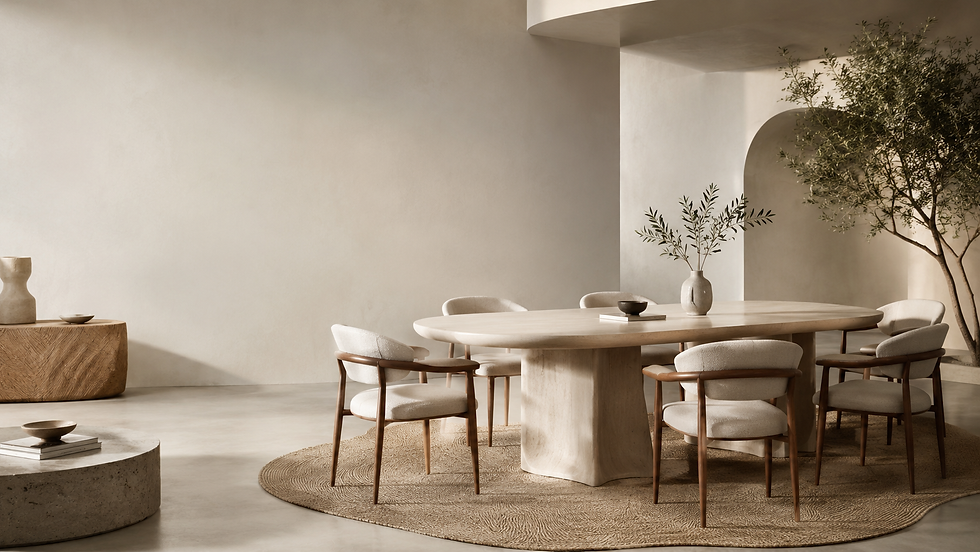
Round Dining Table for 4 or 6: When Does Round Get Too Big?

A 4-person round dining table (100 cm to 120 cm / 40" to 48" in diameter) creates an intimate, conversational atmosphere without consuming disproportionate floor space. However, jumping to a 6-person model requires a diameter of at least 140 cm to 150 cm (55" to 60"). Because circular surface area expands by the square of the radius, expanding from 4 to 6 seats increases the table footprint by roughly 40% to 56%. If your dining room is under 3.6 meters (12 feet) in width, a permanent 6-seat round table can choke primary walkways and create awkward dead zones, making an oval or extendable silhouette a far superior functional choice.
To make an informed purchase, you must evaluate the geometry of round seating, clearance zones, and how your household utilizes dining space on a daily basis.
Quick Comparison: 4-Person vs. 6-Person Round Dining Table Dimensions
The table below details standard spatial requirements, perimeter allocations, and minimum room clearances for standard round dining setups.
Seater Capacity | Table Diameter | Recommended Perimeter per Diner | Minimum Room Dimensions | Ideal Room Clearance |
4 Persons | 100 cm – 110 cm (40"–44") | 78 cm – 86 cm (31"–34") | 2.8 m × 2.8 m (9.2 ft × 9.2 ft) | 90 cm (36") from table edge to nearest wall |
4–5 Persons (Tight) | 120 cm (48") | 75 cm (29.5") | 3.0 m × 3.0 m (10 ft × 10 ft) | 90 cm – 100 cm (36"–40") |
6 Persons (Standard) | 140 cm – 150 cm (55"–60") | 73 cm – 78 cm (29"–31") | 3.6 m × 3.6 m (11.8 ft × 11.8 ft) | 105 cm – 120 cm (42"–48") |
6–8 Persons (Large) | 160 cm – 180 cm (63"–71") | 63 cm – 70 cm (25"–27.5") | 4.2 m × 4.2 m (13.8 ft × 13.8 ft) | 120 cm + (48"+) |
The Spatial Math: Why a Round Dining Table Grows Exponentially
When buying a rectangular table, adding two seats simply lengthens the tabletop by 40 cm to 60 cm along the perimeter while keeping the depth uniform (usually 85 cm to 95 cm). The footprint scales linearly along one axis.
A round dining table behaves entirely differently due to circular geometry. When you increase the diameter from 110 cm (a comfortable 4-seater) to 150 cm (a dedicated 6-seater), the diameter grows by roughly 36%, but the floor surface area balloons from approximately 0.95 m² to 1.77 m²—an 86% expansion in total horizontal space.

This dramatic volumetric surge has two direct consequences on your room layout:
Expanded Radial Clearance: You do not just need clearance on two sides; you need a 360-degree perimeter of at least 90 cm (36 inches) for chair movement and 110 cm to 120 cm (44 to 48 inches) for active thoroughfares.
The Inaccessible Center Zone: In tables with a diameter of 150 cm or larger, the center point sits 75 cm away from every diner. Reaching serving dishes across the middle becomes difficult without standing up, often requiring a lazy susan or secondary serving furniture.
Room Fit and Clearance: Assessing Your Architecture
A round dining table requires a specific room geometry to shine. Square rooms and open-plan dining-living zones with centered lighting are ideal candidates. In contrast, long, narrow dining zones (such as a 4.5 m × 2.7 m layout) suffer when fitted with a large round piece.
To test whether a round format fits your room, follow this three-step clearance calculation:
Step 1: Measure Total Room Width. Identify the narrowest physical span between your walls, radiators, or fixed cabinetry.
Step 2: Subtract Dual Perimeter Buffer. Deduct 180 cm to 220 cm (90 cm to 110 cm per side) from the total room width to account for chair pushback and standard passage.
Step 3: Compare Remainder to Table Diameter. If your room is 3.2 meters wide, subtracting 2.0 meters of total clearance leaves 1.2 meters (120 cm). A 120 cm table fits cleanly for 4 seats, but a 140 cm or 150 cm 6-seat table will encroach into circulation paths, causing chairs to bump walls and block natural transit.
Visual Weight and Pinch Points: When Round Becomes a Risk
Beyond raw square meters, the visual weight of a large round dining table can alter how a home feels. A 150 cm round table with four perimeter legs creates visual clutter under the tabletop, while a central pedestal design requires a substantial base plate to maintain stability against tipping.
Common warning signs that a round shape has become too large for your home include:
Doorway and Cabinet Interference: Chairs pulled out at an angle catch the swing radius of terrace doors, low kitchen drawers, or sideboard cabinets.
Sightline Obstruction: In open-concept living rooms, a wide circular tabletop blocks straight sightlines, making the dining zone feel heavier than a sleek linear table.
Inflexible Guest Scaling: While a rectangular table can be shifted flush against a wall for parties or pushed slightly to one side, a large round table must remain centered to maintain balanced circulation.
Smart Solutions: When to Choose Oval or Extendable Designs
If you regularly host 4 people on weekdays but need seating for 6 guests on weekends or holidays, committing to a permanent 150 cm circular table is rarely the most practical path. Consider these strategic alternatives:
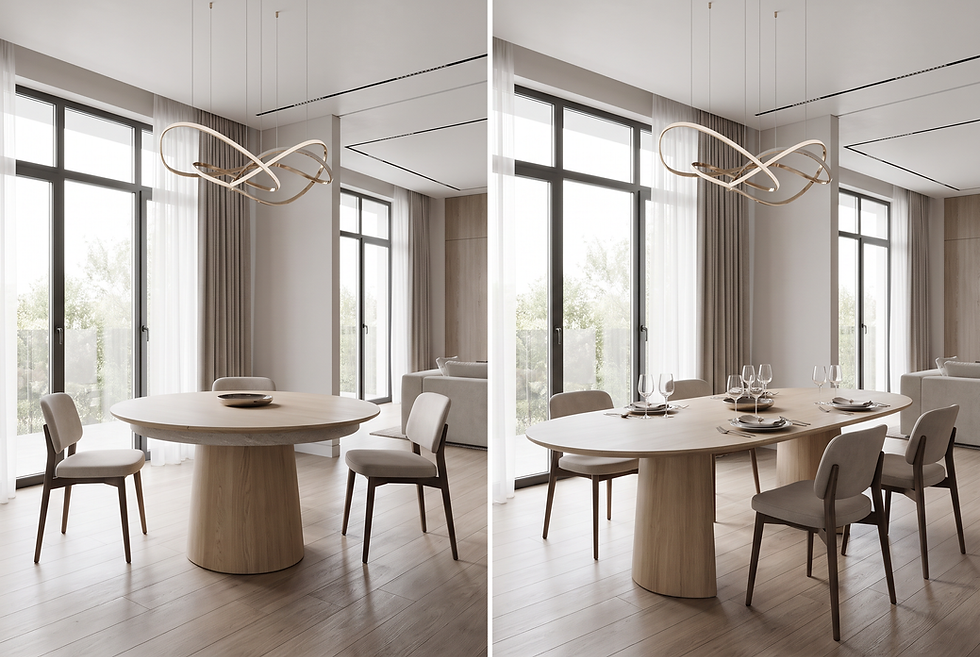
Extendable Round Tables: Start with a compact 105 cm to 115 cm circle for daily living. Integrated butterfly leaves transform the table into an elongated oval (155 cm to 170 cm long) only when extra guests arrive, preserving floor space 90% of the year.
Fixed Oval Tables: Oval designs combine the soft, corner-free flow of a round table with the elongated efficiency of a rectangle. A 160 cm × 90 cm oval table seats 6 comfortably while fitting effortlessly into long, narrow rooms where a 150 cm circle would block traffic.
Pedestal Bases vs. Four Legs: If you must maximize seating on a 120 cm to 130 cm round top, select a central pedestal. Removing perimeter corner legs frees up knee room, allowing you to comfortably squeeze a fifth or sixth guest in for informal meals without leg clashes.
FAQ
What is the minimum diameter for a round dining table seating 6 people?
A round dining table for 6 people requires a minimum diameter of 140 cm (55 inches) for casual dining and 150 cm (60 inches) for standard place settings and serving dishes.
How much space is needed around a round dining table?
You should maintain at least 90 cm (36 inches) between the table edge and the wall or furniture for chair movement, and 110 cm to 120 cm (44 to 48 inches) if the space serves as a primary walkway.
Is a round or rectangular table better for a small dining room?
For square rooms or open nooks under 3 meters wide, a 4-seater round dining table (100–110 cm) is better. For long, narrow rooms, a slim rectangular or oval table uses floor space more efficiently.
Can you comfortably squeeze 6 chairs around a 120 cm round table?
A 120 cm (48-inch) round table is optimized for 4 adults. You can temporarily seat 5 or 6 people for drinks or dessert, but dinner place settings will overlap significantly.
Find the Right Table Proportion for Your Floor Plan
Share your exact room dimensions and everyday guest count, and our design specialists will help you determine whether a round, extendable, or oval dining silhouette delivers the ideal spatial balance for your home.


Comments