


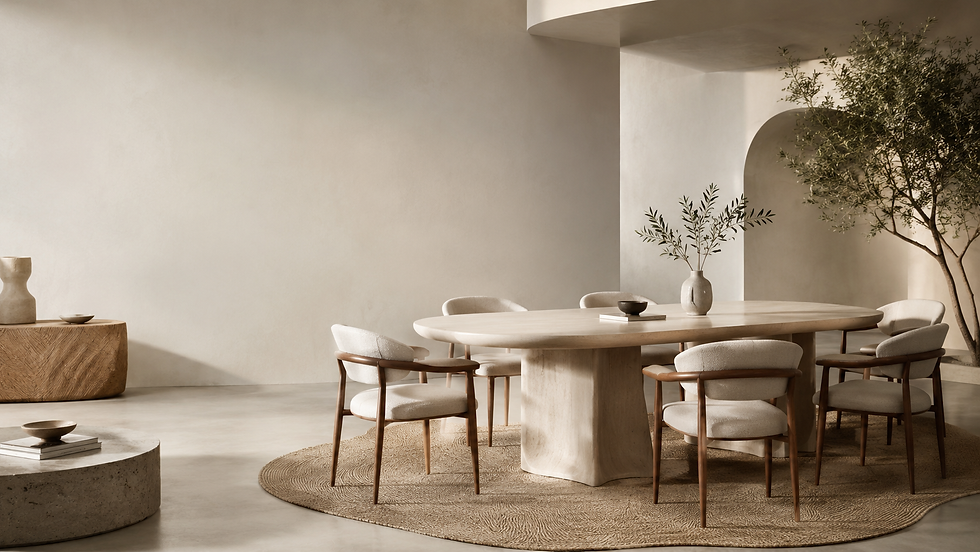
Styling Dining Chairs Set of 4: Round vs Rectangular Tables

The Architectural Geometry of Seating Four
When curated with intention, a dining space transcends utility to become a study in proportion, texture, and quiet luxury. Committing to a dining chairs set of 4 is often the definitive choice for modern dining rooms, urban flats, and intimate breakfast rooms alike. However, placing four identical or complementary seats around a round table yields a completely different spatial rhythm than positioning them along a rectangular surface.
While four chairs might sound straightforward, the table silhouette fundamentally dictates sightlines, elbow clearance, under-table leg interference, and overall movement through the room. Understanding how your table geometry interacts with a four-chair arrangement allows you to cultivate an environment that feels both effortless and architecturally grounded.
Round vs Rectangular: Core Spatial Dynamics for a Dining Chairs Set of 4
Choosing between round and rectangular tables for four chairs involves assessing circulation pathways, perimeter boundaries, and the dialogue between table bases and chair legs.
Spatial Criterion | Round Table Configuration (Ø 100–120 cm) | Rectangular Table Configuration (120–160 cm) | Spatial Impact |
Seating Orientation | Radial, facing a central conversational focal point | Linear pairings, facing directly across or at ends | Affects conversational intimacy and peripheral sightlines |
Base Clearance | Pedestal base avoids leg clashes; 4-leg bases create narrow quadrants | Four corner legs define clear bays; trestle bases alter knee width | Determines how fully chairs tuck beneath the table apron |
Armrest Accommodation | Requires continuous perimeter clearance; may crowd adjacent arms | Best suited for end positions (captains) or side pairs with wide spans | Influences outer perimeter footprint and tuck depth |
Room Flow & Walkways | Softens room corners; requires equal circular buffer zones (90–100 cm) | Anchors linear architecture; requires parallel aisleways (80–90 cm) | Shapes movement and visual weight in open-plan spaces |
Visual Weight | Sculptural, organic, floating presence in square rooms | Structured, symmetrical, grounding in elongated dining rooms | Defines whether the dining area feels dynamic or formal |
Round Table Layouts: Radial Balance and Fluid Conversation
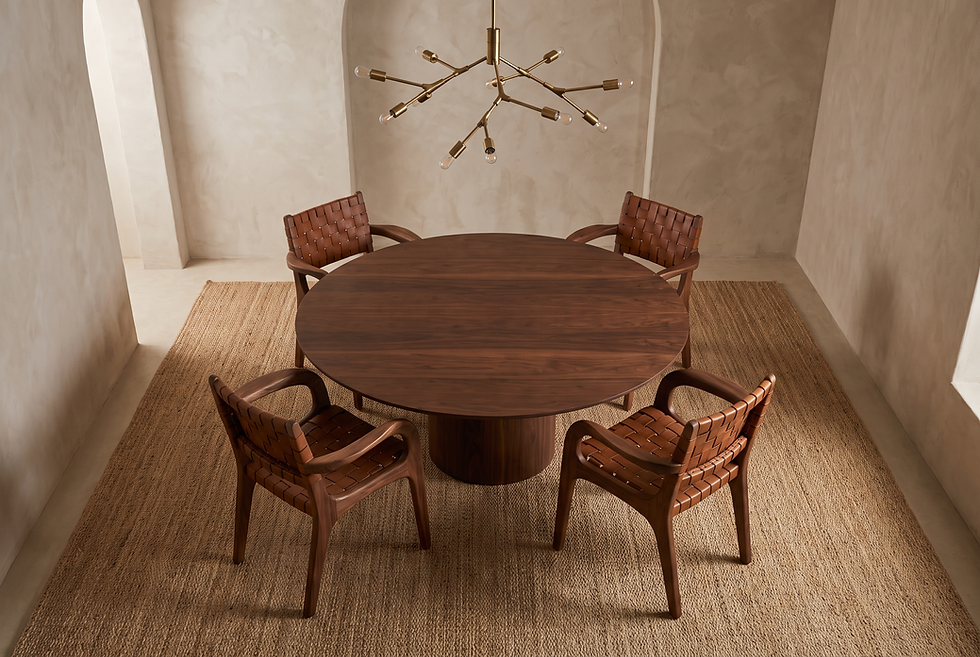
Around a circular table, four chairs naturally arrange into a cross formation at ninety-degree intervals. This radial orientation democratizes the table, placing every guest equidistant from the center and creating an intimate setting reminiscent of classic European salons.
Centering and Radial Alignment
In a round configuration, chair backrests face outward toward the surrounding room. Because every angle is exposed, the back silhouette of your chairs becomes a primary design feature. Low-profile curved cane backs, fluted solid wood, or tailored upholstery can soften the geometric presence of the room. When arranging your set:
Align each chair precisely with the cardinal points or bisecting angles of the room.
Maintain at least 60 cm of perimeter arc distance between seat centers to ensure guests have ample elbow room when dining.
Ensure the dining pendant or chandelier hangs dead-center above the table surface to anchor the radial balance.
Under-Table Leg Collisions and Pedestal Advantages
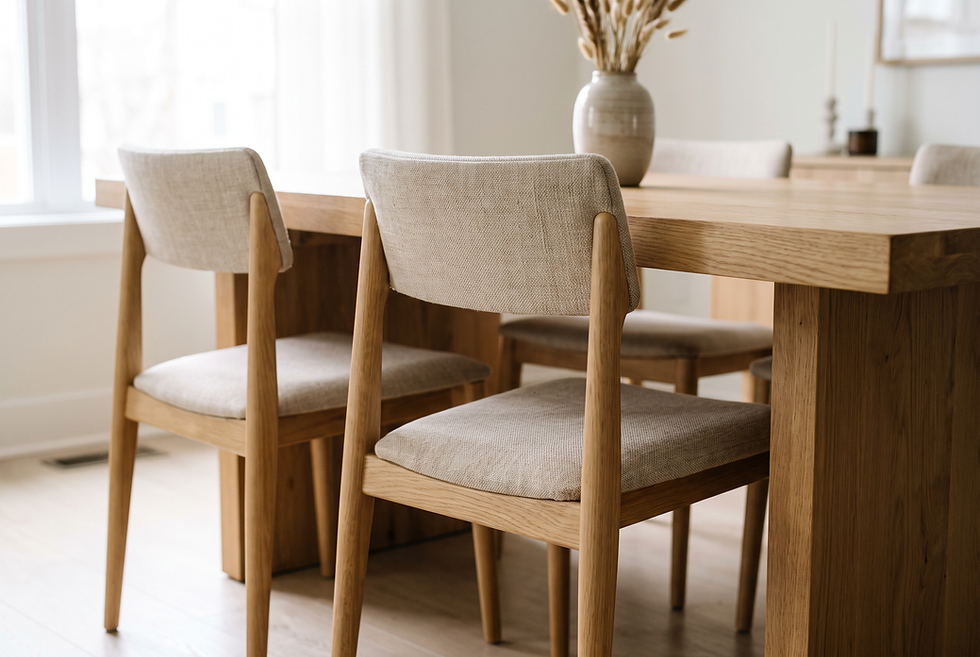
The most frequent challenge when styling a dining chairs set of 4 around a round table is base interference. A traditional four-legged round table creates four narrow openings. If the chair footprint is wide or splayed, the chair legs can easily collide with table legs, preventing the seats from tucking in neatly.
A central pedestal table or tulip base eliminates this conflict entirely. It provides uninterrupted legroom, allowing your four chairs to slide seamlessly beneath the tabletop when not in use, preserving clean visual lines throughout the space.
Rectangular Table Layouts: Symmetry, End Placements, and Linear Rhythm
Rectangular tables introduce directional axis and linear symmetry. With four chairs, you are presented with two distinct curation strategies: the 2x2 lateral pairing or the 1+1+1+1 perimeter arrangement.
The 2x2 Lateral Pairing (Side-by-Side Elegance)
Placing two chairs on each long side leaves the narrow ends open. This creates a balanced, clean look that works exceptionally well against long walls or architectural windows.
Clearance Between Chairs: Ensure your table length provides at least 15 to 20 cm of breathing room between adjacent chair frames.
Table Apron & Corner Posts: Check that the interior width between the table legs accommodates both chair widths combined without forcing them to touch.
Uninterrupted End Views: Leaving the end profiles open visually elongates the room, allowing sightlines to flow freely across the space.
The 1+1+1+1 End-and-Side Arrangement
Placing one chair at each table head and one on each long side creates a classic formal presence. This layout distributes seating evenly across all four sides of the rectangle, echoing the balance of a round table while preserving architectural lines.
Armchair Inclusion: This setup allows you to use chairs with sculptural armrests at the head and foot of the table without crowding the side seats.
Clearance for End Pull-Outs: Make sure to leave at least 90 cm of clearance at the ends of the table so guests can push back comfortably without hitting walls or sideboards.
Armrest Dynamics: Proportion, Tuck Depth, and Width
Choosing between armless side chairs and enveloping armchairs alters both ergonomics and visual weight in a four-seat dining area.
Armchairs on Circular Perimeters
On a round table, armrests expand the chair footprint outward along the arc. If the tabletop diameter is under 110 cm, four wide armchairs may look visually heavy or touch at their widest points. Opt for integrated, curved half-arm designs or sculptural low-slung armrests that nestle gracefully under the tabletop.
Armchairs on Rectangular Profiles
On a rectangular table, side-by-side armchairs require a minimum table length of 140 to 160 cm to prevent elbows and chair arms from bumping. If working with a compact rectangular table (120 to 130 cm), consider placing armless chairs along the sides, or switch to the head-and-foot layout to give each armchair dedicated space.
Spatial Clearances and Visual Rhythm for Everyday Living
Regardless of table silhouette, true dining luxury relies on effortless proportion and comfortable spatial flow. Consider these refined clearance rules when positioning your four chairs:
The 90 cm Perimeter Standard: Maintain a perimeter walkway of 90 to 100 cm between the table edge and surrounding walls, credenzas, or doors. This ensures guests can walk behind seated diners with ease.
Tuck Depth and Seat Height: A standard seat height of 45 to 48 cm paired with a 75 cm high table offers optimal ergonomic clearance (roughly 25 to 30 cm from seat to underside of table).
Flooring & Rug Proportions: When placing your four-chair dining set on an area rug, ensure the rug extends at least 60 cm beyond the table perimeter on all sides. This allows chair legs to stay on the rug even when pulled out for seating.
FAQ
Can I use a dining chairs set of 4 with a square dining table?
Yes. A square table (90x90 cm to 100x100 cm) is an excellent alternative for four chairs, offering the one-chair-per-side symmetry of a round table along with clean, linear architectural edges.
What is the ideal table diameter for a dining chairs set of 4 on a round table?
A round table diameter between 100 cm and 120 cm is ideal for four chairs. It provides comfortable personal dining space and elbow clearance without making conversation feel distant.
How do I prevent chair legs from clashing with four-legged dining tables?
Measure the inner distance between table legs rather than total tabletop width. Choose chairs with narrow footprints or switch to a central pedestal or trestle table design to eliminate leg collisions.
Should all four dining chairs match, or can I mix silhouettes around a rectangular table?
You can mix styles by placing two statement armchairs at the head and foot while using two matching armless side chairs along the long edges, creating a curated, layered look.
Refine Your Dining Space Layout
Send us a photo of your dining table along with your four favorite chair designs, and our interior specialists will verify clearances, leg alignments, and spatial balance for your home.


Comments