


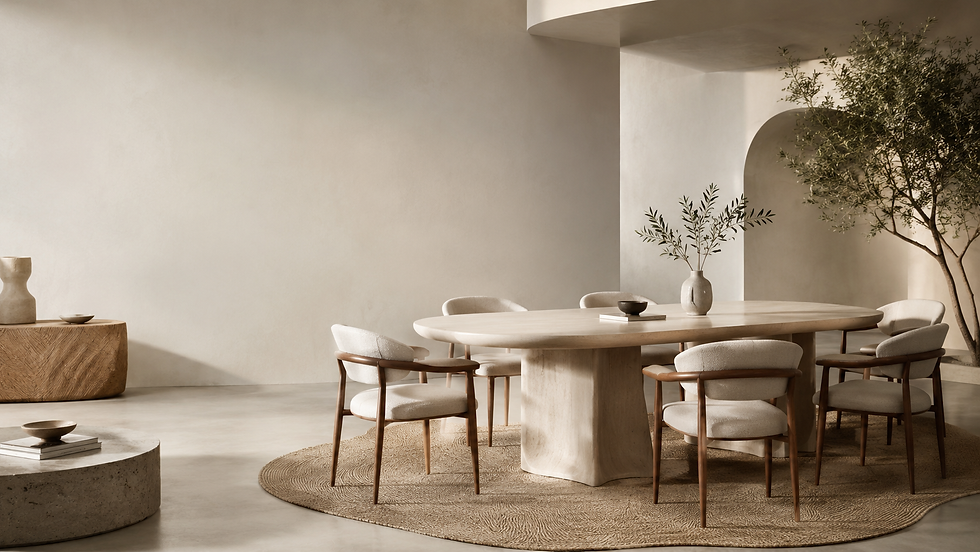
Upholstered Dining Chairs: 6 Details That Define Quality and Form

Selecting upholstered dining chairs often reveals an unexpected gap between catalog photographs and everyday reality. A chair that looks plush on a screen can feel bulky, stiff, or visually overwhelming once placed around an actual dining table. True quality in dining seating does not stem from decorative excess; it is defined by disciplined proportions, precise tailoring, and a silhouette that looks balanced from every viewing angle.
At a Glance: The Evaluation Framework
Primary Viewpoint: Dining chairs are viewed from behind 80% of the time. The rear backrest and top rail must offer a clean, resolved line.
Table Proportions: Arm height, seat drop, and backrest elevation must maintain a clear relationship with your tabletop clearance.
Tailoring Discipline: Tight seam alignment, well-anchored foam wrapping, and tensioned upholstery prevent premature puddling and sagging.
Base Architecture: The transition from soft upholstery to wood or metal framing should feel integrated rather than bolted on as an afterthought.
Evaluating Upholstered Dining Chairs: The 6 Defining Details
When assessing high-grade dining seating against generic alternatives, look closely at these six structural and aesthetic markers.
1. The Rear Profile and Back Silhouette
In most residential dining rooms, chairs are pushed under the table when not in use. You rarely see the front cushion first; instead, you encounter a line of chair backs. Generic designs frequently treat the back panel as a flat afterthought, using visible staples, uneven piping, or loose fabric panels.
Refined upholstered dining chairs feature a gently sculpted back panel with tensioned seams or hidden blind stitching. Whether the profile is gently curved to embrace the spine or vertically linear, the rear surface should present a calm, uninterrupted plane that complements the tabletop rather than cluttering the sightline.
2. Seat Depth, Drop, and Apron Clearance
A common issue with dining upholstery is incorrect proportional scaling. Chairs repurposed from accent chair concepts often feature seats that are too deep (exceeding 21 inches) or too reclined, forcing diners to lean forward awkwardly during meals.
Properly proportioned dining chairs prioritize an active upright posture with ergonomic lumbar support. If you choose an armchair style, measure the clearance between the top of the chair arm and the underside of the table apron. A minimum gap of 1.5 to 2 inches is recommended to prevent accidental contact and fabric abrasion when tucking the chair away.

3. Tailoring Precision and Edge Transition
The longevity of upholstery depends heavily on internal foam shaping and outer seam tension. Lower-tier seating relies on loose polyfill batting that quickly loses shape, resulting in surface ripples within months of regular use.
Look for high-density, multi-layer cushioning wrapped in structured interliners. Welting, double-topstitching, or clean knife-edge seams should run laser-straight along the frame contours. When you press down firmly on the seat center, the fabric should recover its tautness immediately without leaving stretch marks or puckering around the stitching.
4. Structural Base Integration and Weight Distribution
A dining chair experiences constant directional stress as people slide, shift, and recline. Generic models often attach spindly legs to a basic wooden subframe using exposed corner brackets, leading to wobbling over time.
Superior construction employs solid hardwood internal frames or engineered steel skeletons. Notice how the legs meet the upholstered seat pan. A deliberate transitional collar, a recessed sub-base, or a continuous architectural sled base reflects engineering intentionality and ensures quiet, long-term stability.
5. Visual Weight and Room Breathing Room
A room furnished with eight heavy, fully skirted, or blocky upholstered chairs can quickly feel overcrowded. Balancing upholstered comfort with spatial lightness is an essential interior design consideration.
To keep an open-concept dining area feeling expansive, consider combining fully upholstered side chairs with open-base or slender-profile designs. Pay attention to the negative space beneath the seat. Tapered legs, slim tubular frames, or open lower back cutouts allow light to pass through the room, keeping the dining arrangement grounded yet visually light.

6. Textile Honesty and Tactile Depth
Dining chairs interact with hands, clothing, and natural ambient light throughout the day. Flat, synthetic fabrics with an artificial sheen tend to highlight every seam flaw and flatten the room's atmosphere.
Prioritize textiles with rich tactile dimension—such as textural bouclés, structured flatweaves, tailored wool-blends, or smooth performance velvets. These materials absorb and reflect light naturally, lending depth and subtle shadow to the curves of the chair while offering durable, everyday practicality.
Comparison: High-Craft vs. Generic Dining Chair Upholstery
Evaluation Metric | High-Craft Tailored Dining Chair | Generic Mass-Market Dining Chair |
Rear Backrest Design | Sculpted curvature, hidden seam closures, architectural presence | Flat rectangular boards, exposed staples, visible zipper tracks |
Foam & Cushion Core | Multi-density supportive core with immediate rebound | Low-resilience single-layer foam prone to early sagging |
Seam Construction | Reinforced double-stitching, knife edges, or crisp welting | Single loose stitching, visible tension pulling at corners |
Frame Integration | Engineered internal joints, balanced weight, seamless leg joinery | Bolted surface plates, frequent loosening, light unstable feel |
Dining Ergonomics | Balanced upright posture with integrated lumbar support | Overly deep or reclined seat forcing unnatural forward lean |
How to Choose the Right Silhouette for Your Floor Plan
To select the ideal upholstered dining chairs for your home, match the chair’s profile with your dining table's geometry and traffic flow:
Rectangular Tables (8+ Seats): Pair tailored, armless side chairs along the lengths with subtly broader armchairs at the heads to create visual anchor points.
Round or Oval Tables: Curves invite curved seating. Choose chairs with rounded barrel backs or soft radius corners that follow the perimeter of the tabletop naturally.
Compact Dining Areas: Select chairs with slim backrests and elevated, slender leg frames to preserve sightlines and floor visibility.
Practical Review Steps Before You Commit
Verify Clearance: Measure your table height, underside apron height, and the distance between table legs to ensure armchairs slide in smoothly.
Inspect from Every Angle: Review side and back elevations, not just front product shots, to confirm visual harmony with adjacent living areas.
Assess Material Tactility: Request fabric swatches to evaluate undertones against your existing flooring, wall paint, and tabletop finish under both day and evening lighting.
FAQ
How do I determine the right seat height for upholstered dining chairs?
Standard dining tables stand between 29 and 30 inches high. The ideal seat height for dining chairs is 18 to 19 inches from the floor to the crown of the seat cushion, providing comfortable legroom of roughly 10 to 12 inches between seat and tabletop.
Can upholstered dining chairs work well in homes with active daily use?
Yes, provided you choose tightly woven textiles, structured flatweaves, or treated performance fabrics. Avoid loose, open weaves or delicate sheer linens that catch easily, and select foam cores with high density that retain their form over time.
Should all dining chairs around the table match completely?
Not necessarily. A widely accepted approach is using upholstered armchairs at the head and foot of the table for subtle emphasis, paired with streamlined side chairs along the sides in a coordinating fabric or complementary frame finish.
How do I prevent armchairs from bumping into the table apron?
Measure the distance from your floor to the lowest point of the table apron, then compare it to the chair's arm height. Ensure at least a 1.5-inch clearance so the chair can slide beneath the table without scuffing the upholstery or wood.
Find the Right Balance for Your Dining Space
Shortlist 2–3 chairs from our collection and consult Bonne Casa to compare proportion, material texture, and room fit for your floor plan.


Comments